02/2026 Renan Enrique dos Santos
Age: 35 | Nationality: Brazilian
Can you briefly introduce yourself and tell us where you’re from?
I am Renan, 35, Brazilian, and I have had quite a non-linear academic trajectory up to this point: a Bachelor’s in International Relations, another in Economics, then a number of credits in Literature and Linguistics from different institutions.
What are you studying, and why did you choose this degree program?
I’m at the end of my first semester in a Master in Linguistics, which is at once a very exciting change in my academic trajectory, and an opportunity to align it to my passion for language studies. Beyond that, the program in Potsdam sounded all the more interesting for it is a Master of Science, rather than Arts, which I think suits me well.
Was there anything about studying in Germany that surprised you?
Many things, actually! But most of all, that it is not uncommon for the entire grade of a particular course to depend exclusively on the final exam; and that there is such a long gap between the end of classes in one semester and the beginning of the next.
What’s your favorite thing about studying at University of Potsdam?
The partly untrue answer is seeing Neues Palais on a somewhat regular basis! I study in Golm, but I’ll use every excuse I can to go to that campus, simply because you can’t beat that view! But now to the truth: one of my favorite aspects is how diverse and international a group of students and professors there is here, which only enriches the experience. Plus, the library at the Golm campus is remarkable: comfortable and well-equipped.
What role does the German language play in your studies, daily life and your plans for the future?
First of all, I truly enjoy learning and speaking German. I’ve got a lot to improve, but it is an important part of my daily life, and it makes many things easier: making friends, moving around the country, and dealing with bureaucracy, since you won’t find English speakers in most public offices, for instance. It does not yet play an expressive role in my studies, given the program is offered in English, but it will be more prevalent if I get to stay longer in the country, for study or work.
What do you like most about living in Berlin and studying in Potsdam?
The commute is fairly comfortable, I must say: one U-Bahn to the nearest train station and then a regional train to Potsdam. This allows me to experience the life of a big city, something I have always wanted to, but also to retreat and find a rather peaceful atmosphere for studying.
How are you experiencing your first (and cold) winter here? Any special moment?
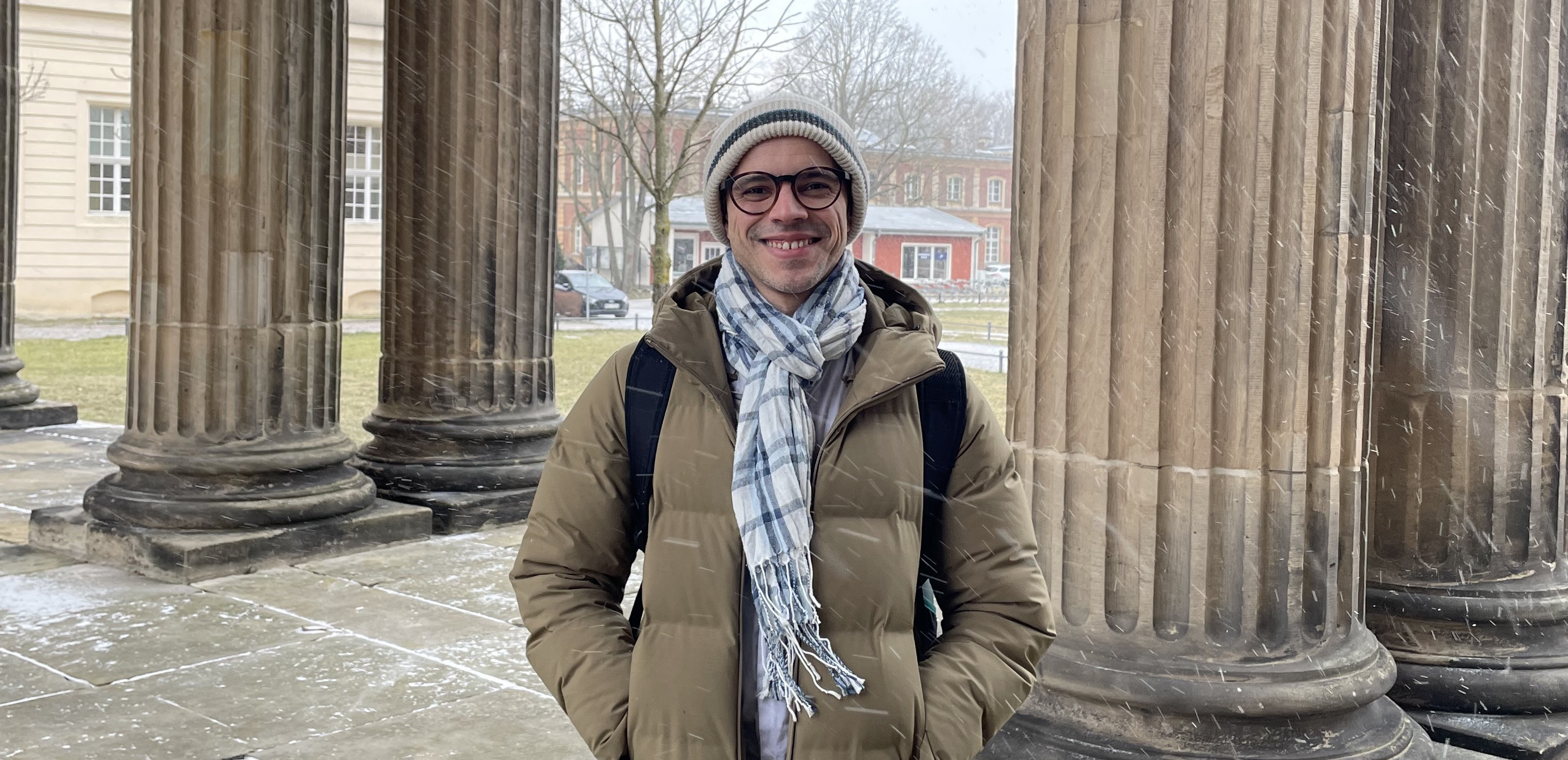
Theres a lot to unpack here! This being the coldest winter in over a decade did not help this poor tropical immigrant, but the hardest part is the greyness, the long-lasting cloudiness of these months. But on a brighter note, the first week of snow was truly beautiful, and to walk over that coat of white for a few days did help lift my spirits.
Was it easy for you to connect with other students?
Perhaps this is my actual favorite part about studying here: it was quite easy. I’m lucky my class is full of likewise motivated peers and, since we all enrolled in an English instructed program, there were no language barriers from the start, which made communication easy. In fact, I feel the department as a whole is quite friendly and welcoming.
What advice would you give to future international students coming to Potsdam/Berlin?
There’s so much that comes to mind, but I suppose I would advise them to start working on paperwork and applications as early as possible, because that can also mean receiving the letter of acceptance sooner, which helps loads! I myself applied as early as I could, but since it was somewhat closer to the deadline, I had only five weeks between acceptance and the beginning of the semester, which meant I had to organize a whole move to a different country in record time. It all went well, but some of this kind of stress can be avoided.
What are your plans for the future?
Right now, the plan is to actually start planning the next few semesters! I would love to stay in the country longer than the duration of the master’s program, and I’m now getting a clearer idea of which core areas of Linguistics intrigue me the most, so the future might hold a PhD, let us wait and see. But the most immediate side quest is to go back to being a language nerd and study German again.